
Domain-Driven Design in Practice: Mastering Complexity and Structuring Software Strategically
Why Modern Software Architecture Doesn’t Start with Technology – and How DDD Aligns Business and Code for Long-Term Success

🧭 Table of Contents
Introduction
Why Domain-Driven Design Matters Today
What Is Domain-Driven Design?
When to Use DDD – and When Not To
The Core Building Blocks of DDD
The DDD Process Model
DDD in the Cloud and Microservices Context
DDD + Cloud = Success Formula
DDD as a Strategic Enabler
DDD as a Compass for Real Complexity
Call to Action
✍️ 1. Introduction
In today’s software development landscape, writing clean code or exposing APIs is no longer enough. If you’re building systems tightly interwoven with complex business processes like those in finance, logistics, or e-commerce you’ll quickly hit limits. Stakeholders speak a different language than developers, requirements change faster than architecture can adapt, and technical debt silently grows in the background.
Domain-Driven Design (DDD) offers a way out in these situations. It’s not a framework, but a mindset and a toolbox that systematically connects business logic, architecture, and code. Instead of being driven by technical details, DDD puts domain understanding and clear business structuring at the heart of development.
💡 2. Why Domain-Driven Design Matters Today
Modern software projects are no longer built in isolation within IT departments. They are embedded in complex business processes, often spanning multiple departments or organizations. Business units demand rapid iteration, while expectations around scalability, maintainability, and compliance continue to grow.
This is where many projects fail: developers and business stakeholders talk past each other. Requirements are interpreted technically but implemented incorrectly from a business perspective. Systems grow uncontrollably and lose their business clarity. Technical debt is inevitable.
Domain-Driven Design (DDD) was created to solve exactly this problem: it brings business and technology back into alignment. DDD starts with the domain the business field and real-world processes and helps structure software around the business reality. The result: systems that not only work, but can be understood, evolved, and scaled.
3. What Is Domain-Driven Design?
Domain-Driven Design is both a strategic and tactical approach to designing complex software systems. The concept was coined by Eric Evans in his seminal book “Domain-Driven Design: Tackling Complexity in the Heart of Software” (2003).
The core idea: Software architecture should be shaped primarily by the domain, not by technology. DDD encourages close collaboration between developers and domain experts to build a deep, shared understanding of the business and translate that into a well-structured, expressive model.
DDD is not a technology or tool, it’s a methodology, a mindset, and a shared language for modeling software around a business domain.
At its heart lies the principle of Ubiquitous Language a common, shared language used by everyone involved: in meetings, documentation, and code.
4. When to Use DDD – and When Not To
4.1 Ideal Use Cases for DDD ✅
High Business Complexity: When the logic is non-trivial e.g. finance, e-commerce, logistics, or insurance.
Long-Lived Systems: When long-term maintainability and adaptability are key.
Diverse Stakeholders: When developers, business, product owners, and compliance teams need to collaborate closely.
Microservice Architectures: DDD helps define services along domain boundaries (Bounded Contexts).
Scaling and Agility: When teams and services need to evolve independently.
4.2 When DDD Is Not a Good Fit ❌
CRUD-only Applications: Where business logic is minimal (e.g. admin backends or internal tools).
Prototyping or MVPs: When speed matters more than structure, and the domain is still unclear.
Lack of Business Domain: For tools that are mostly technical in nature (e.g. monitoring tools, platforms).
Limited Resources or Experience: DDD requires expertise, facilitation, and effort it pays off only with sufficient complexity.
4.3 Alternatives 🔄
Layered Architecture or classic Service-Oriented Architecture (SOA).
CRUD-based Approaches for simple systems.
Modular Monoliths as a stepping stone if DDD seems too ambitious at first.
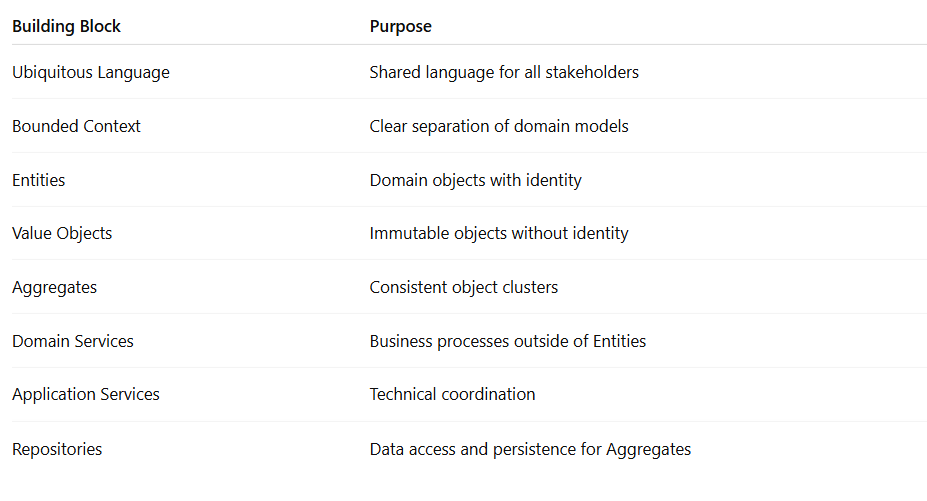
5. The Core Building Blocks of DDD
Domain-Driven Design relies on a clear, linguistically and conceptually consistent structure. Its key concepts help achieve business clarity, technical separation, and maintainability, especially in large teams or distributed environments.
5.1 Ubiquitous Language 🧩
All participants developers, architects, domain experts use a single, unified language based on the vocabulary of the domain. This language is used in code, tests, documentation, and conversations.
Example: A customer is not called
User,CustomerEntity, orPersonDTOin code—it is simplyCustomer, just as in the business.
The goal is to eliminate misunderstandings and make the domain model directly recognizable in the code.
5.2 Bounded Context 🧱
In complex systems, the same term may mean different things in different contexts. A Bounded Context is a well-defined boundary where a specific domain model applies.
Example: In an e-commerce system, “Order” might mean something different in logistics than in payment.
Bounded Contexts help define clear interfaces and separate responsibilities ideal for splitting microservices.
🧠 Pro Tip: A Bounded Context is not just a database or a module it’s a coherent conceptual space with its own language, structure, and logic.
5.3 Entities, Value Objects, and Aggregates 🧬
DDD uses tactical patterns to model domain logic precisely in code:
Entities
Objects with identity and lifecycle. They are mutable.
Example:Customer,Order,UserAccountValue Objects
Objects with no identity, defined solely by their attributes. They are immutable.
Example:Address,MoneyAmount,PhoneNumberAggregates
A cluster of Entities and Value Objects treated as a single consistency boundary. Aggregates encapsulate invariants and expose only the root entity.
Example: AnOrder(Aggregate Root) consisting of multipleOrderItems.
💡 Aggregates help define consistency boundaries crucial for distributed systems or eventual consistency.
5.4 Domain Services & Application Services 🧰
Domain Services contain business logic that doesn’t naturally belong to a single Entity. They often work across multiple Aggregates.
Example: Price calculation, credit checksApplication Services coordinate technical workflows, e.g. calling multiple domain services, repositories, or external systems.
Example: Create an order, save it, send confirmation email
5.5 Repositories & Anti-Corruption Layer 🗂️
Repositories abstract access to data sources (e.g. databases) and return domain objects.
Example:IOrderRepository.FindById(orderId)Anti-Corruption Layer (ACL) shields a Bounded Context from external models. The ACL transforms data, prevents semantic conflicts, and provides a well-defined interface to the outside world.
5.6 Summary 🎯
6. The Process Model for Domain-Driven Design
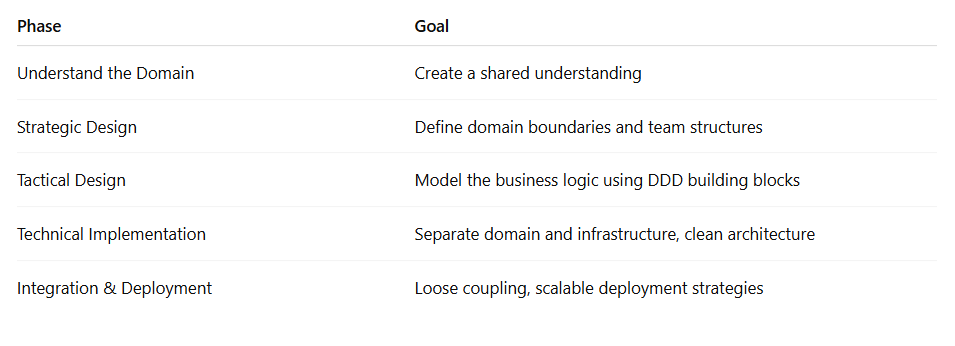
Domain-Driven Design is neither a waterfall model nor a plug-and-play framework. It is an iterative process model structured into two major levels:
Strategic Design – What are we building, and where are the domain boundaries?
Tactical Design – How do we model the domain in actual code?
6.1 Understanding the Domain – with Event Storming & Domain Storytelling 🚀
DDD doesn’t start with code. It starts with a deep understanding of the domain. Two proven techniques for this:
Event Storming (by Alberto Brandolini):
Collaborative workshops where all stakeholders visualize domain events along a timeline. Goal: Understand processes, clarify language, uncover conflicts.Domain Storytelling:
Telling concrete business scenarios like “A customer places an order,” identifying roles, systems, and actions. A great starting point for newcomers.
👉 Goal: Ensure everyone involved shares a clear understanding of how the domain works and what it really means.
6.2 Strategic Design – Bounded Contexts & Context Map 🗺️
Once the domain processes are understood, the domain is divided into Bounded Contexts. Each context has its own model, language, and lifecycle.
This is where the Context Map comes in. It visualizes the relationships between the different contexts.
6.3 Tactical Design – Modeling the Building Blocks 🔬
Within each Bounded Context, the tactical design begins. Here, you model:
Entities
Value Objects
Aggregates
Domain Events
Domain Services
…using the previously defined Ubiquitous Language.
6.4 Technical Implementation – Hexagonal Architecture 🏗️
DDD promotes the Hexagonal Architecture (Ports & Adapters):
The domain core is independent of databases, frameworks, or external APIs.
External systems (e.g., databases, REST, Kafka) are connected through adapters that implement interfaces (ports).
📌 Benefit: Your domain model remains testable, clean, and framework-independent.
6.5 Integration & Deployment 📦
Depending on complexity, your system may be broken into Microservices, Self-Contained Systems, or a Modular Monolith. Key considerations:
Asynchronous communication via events (e.g., Kafka, Event Grid)
Independent deployment per Bounded Context
Infrastructure as Code (e.g., using Terraform) to ensure consistency across environments
6.6 Summary of the DDD Process Model 🧠
7. Domain-Driven Design in the Context of Cloud and Microservices
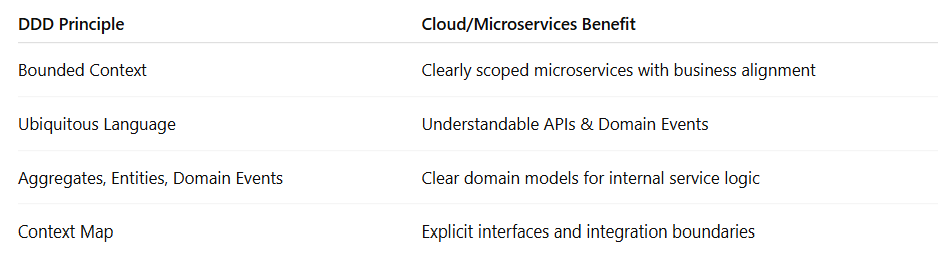
Domain-Driven Design (DDD) is a great fit for modern, distributed systems, especially Microservices and Cloud architectures. Why? Because it helps to untangle complexity, clearly define responsibilities, and enable evolutionary development.
💡 Why DDD and Microservices work so well together
7.1 Architecture Principles in the Cloud with DDD ⚙️
7.1.1 One Microservice = One Bounded Context
Each microservice can be deployed independently.
The service represents one business domain, e.g., ordering, payments, shipping.
The domain model remains consistent and autonomous within itself.
7.1.2 Asynchronous Communication via Events
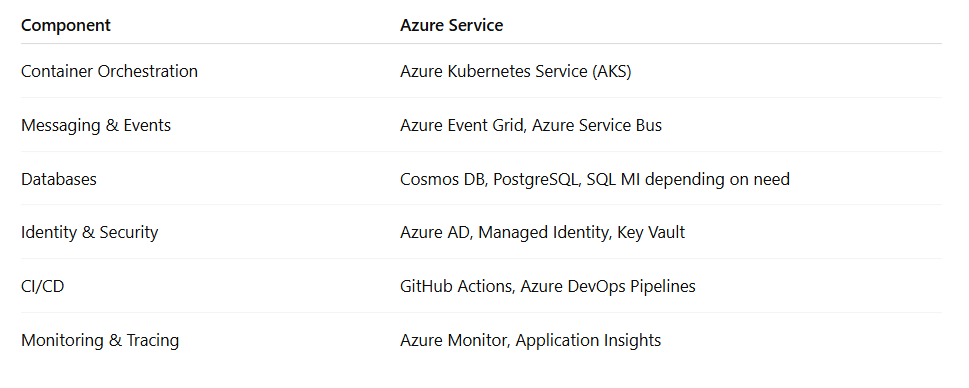
Instead of tight API coupling → use event-driven communication (e.g., via Azure Event Grid, Service Bus, Kafka).
Each service listens for relevant events, independent of the producer.
7.1.3 Cloud-Native Infrastructure
Azure services like:
Azure Kubernetes Service (AKS) for container orchestration
Azure API Management for secure external interfaces
Azure Event Grid / Service Bus for event-driven communication
Azure Key Vault for managing secrets
Azure Cosmos DB or SQL MI, depending on data model requirements
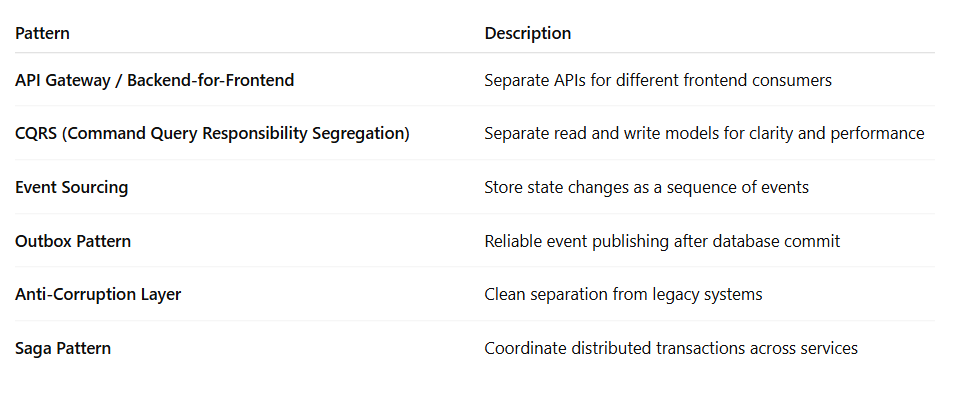
7.2 Relevant Patterns from the DDD/Cloud World 🧩
7.2.1 Azure-Specific Implementation of a DDD System (Example) 📦
7.3 Organizational Recommendations for DDD + Cloud 🧠
Team = Context = Service
→ One autonomous team per Bounded Context, responsible for the entire lifecycle ("You build it, you run it")Introduce Platform Engineering
→ Developers need self-service platforms for deployment, secrets, database access, observability, etc.Automate DevSecOps & Compliance
→ Security and audit requirements should be built into the platform layer
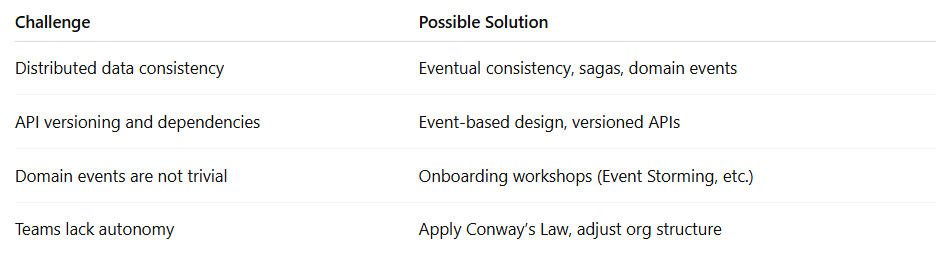
7.3.1 Practical Challenges 🚧
8. DDD + Cloud = Recipe for Success (If Done Right) ✅
If you take Domain-Driven Design seriously, you can build cloud applications that:
remain maintainable in the long term,
can be evolved flexibly from a business perspective,
use cloud resources efficiently,
and allow teams to work autonomously and with focus.
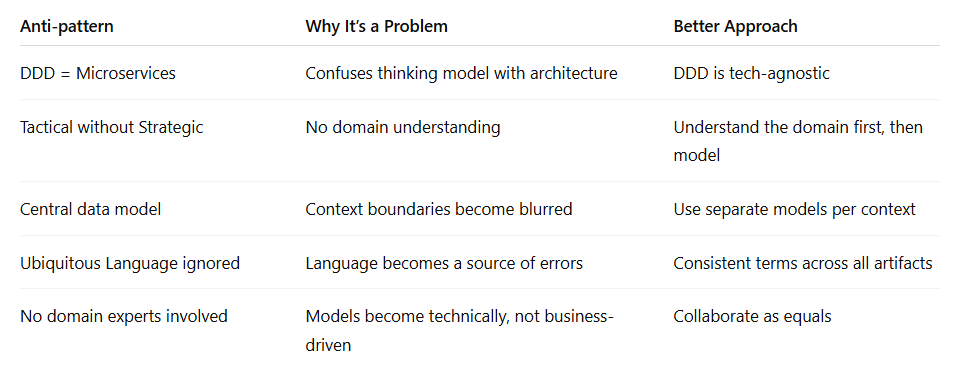
8.1 Misinterpretations and Common Anti-Patterns in DDD
Domain-Driven Design is not a framework or a silver bullet. Many teams misuse or only superficially apply DDD, leading to frustration, unnecessary complexity, and project delays. Here are the most common misunderstandings and anti-patterns from the field.
8.1.1 DDD = Microservices ❌
Many believe DDD is only for microservices. That’s wrong. DDD is a thinking model, not an architecture style.
Anti-pattern:
"We’re doing microservices, so we need to do DDD too!"
Better:
DDD helps you identify business boundaries, regardless of whether you’re building a monolith, a modular monolith, or microservices.
8.1.2 Bounded Contexts = Deployment Units ❌
A Bounded Context is a business-relevant boundary, not a technical module or Docker container. Deployment boundaries and context boundaries may overlap, but they don’t have to.
Anti-pattern:
"Each context must be its own microservice, otherwise it's not real DDD!"
Better:
Define business boundaries first, technical structures second. Often, a modular monolith is the better starting point.
8.1.3 Tactical Design Without Strategic Design ❌
Many developers jump straight to aggregates, repositories, and entities—without understanding the domain or defining bounded contexts.
Anti-pattern:
"We’re modeling our entities now, DDD, right?"
Better:
Start with Event Storming, Domain Storytelling, and Context Mapping before writing code.
8.1.4 The “One Truth” in the Data Model ❌
DDD emphasizes that different contexts may have different views of the same reality. Yet, many teams try to create a "central data model."
Anti-pattern:
"Let’s define a central Customer object that everyone uses!"
Better:
The customer in the "Billing" context is not the same as in "Customer Support." Model a separate customer model for each context.
8.1.5 Ubiquitous Language Is Not Practiced ❌
Many teams claim to use DDD but still rely on technical or inconsistent terminology. The shared language becomes a formality.
Anti-pattern:
"The model is called
OrderDto, but the business refers to it as a booking."
Better:
Language is power. Use the same terms in code, tests, APIs, and conversations as the business side.
8.1.6 DDD Without Domain Experts ❌
DDD only works if business and tech collaborate closely. It’s not just a technical exercise.
Anti-pattern:
"We’re doing DDD, but the business department wasn’t involved in the modeling."
Better:
Include domain experts, product owners, support staff, and ops, anyone who understands the domain.
8.1.7 Aggregates Become Mini CRUD Services ❌
Many aggregates end up being nothing more than collections of CRUD logic, without real domain logic or invariants.
Anti-pattern:
"Our order entity just has getters and setters. That’s our aggregate."
Better:
An aggregate is a unit of business consistency and rules, not just a data holder.
8.1.8 Event Storming as a One-Time Workshop ❌
Many teams run one Event Storming session and then start coding, instead of using it as a recurring practice.
Anti-pattern:
"We did an Event Storming. DDD, check!"
Better:
Event Storming is a continuous communication tool, not just a one-off workshop.
8.1.9 Summary – Typical DDD Anti-Patterns ✅
9. Domain-Driven Design as a Strategic Enabler
Domain-Driven Design is much more than an architectural pattern or modeling methodology. It is a strategic tool for mastering complexity, aligning software and organization, and remaining capable of action in a rapidly changing world.
9.1 Why DDD is a Gamechanger 🎯
DDD brings clarity to complexity
Complex domains cannot be tamed with simple tools. DDD helps bring structure to the chaos, through clear terminology, responsibilities, and boundaries.DDD fosters interdisciplinary collaboration
With DDD, business and tech finally speak the same language. Misunderstandings, silo thinking, and friction are reduced.DDD fits today’s digital world
Modern architectures are distributed, cloud-based, fast-moving. DDD offers a robust mental model for microservices, event-driven systems, CI/CD, DevOps, and cloud-native platforms.
9.2 DDD is Not Just Theory – It’s a Toolbox for Practice 🚀
Domain-Driven Design is not a religion. You don’t have to apply every concept 1:1. But those who understand DDD correctly and apply it pragmatically reap enormous benefits:
More clarity in projects
through Bounded Contexts, Ubiquitous Language, and clear responsibilitiesBetter software architecture
through clean models, loose coupling, and robust integrationsStronger teams and organizations
through interdisciplinary communication, real ownership, and focus on what matters
9.3 When You Should Use DDD 💡
DDD is especially worthwhile when:
your domain is complex and constantly evolving (e.g., in regulated markets, with many dependencies, or deep subject-matter knowledge),
business and IT need to work closely together,
you aim to build long-term maintainable systems,
you plan to implement microservices, eventing, or modularity,
you want to establish scalable and resilient architectures in a cloud environment.
9.4 When to Be Cautious 🙅
Consider skipping DDD, or apply it in a minimal form, if:
your software only handles very simple CRUD processes,
you’re building a proof of concept or MVP where speed outweighs architecture,
you have no access to domain knowledge (or the business is not willing to participate),
your team doesn’t understand DDD or isn’t ready to learn.
9.5 Final Thought ✅
"Software is not just code. It's a reflection of how we understand our business."
DDD is the key to translating this insight into long-lived, maintainable, and value-creating systems.
Those who use Domain-Driven Design not as dogma but as a collaborative thinking model will be rewarded, with clearer products, better architectures, and more satisfied teams.
🧭 10. Domain-Driven Design – A Compass for Real Complexity
Domain-Driven Design isn’t a trend. It’s a strategic compass for modern software architecture. In a world where technology and business are ever more intertwined, DDD provides the structure, language, and clarity teams need to build resilient systems.
Whether you’re rolling out microservices, building an Internal Developer Platform, or simply striving for better domain models, DDD helps you weave technology into real business needs.
But DDD isn’t an end in itself. It only works when you apply it consistently, iteratively, and hand in hand with domain experts. Then it transforms from a “buzzword” into a genuine force multiplier.
📣 11. Call to Action
👋 Your input matters!
Have you worked with DDD already, or are you planning to start? What pitfalls and “aha” moments have you encountered?
👉 Share your experiences in the comments. I look forward to the discussion.
📬 If you enjoyed this article and want regular deep dives into cloud architecture, internal developer platforms, domain-driven design, and platform thinking, then:
➡️ Follow me on LinkedIn
Together, let’s build systems that not only function, but truly reflect the reality of the business.


